
The virtual factory of müller+krahmer – effective and cost-efficient digitalization live
Industry 4.0, the Internet of Things (IoT) and digitalization are on everyone’s lips. Terms such as smart factory, digital twin, augmented reality or big data signal enormous upheavals – and, of course, complex and expensive measures.
But before Industry 4.0, i.e. the networking of systems, comes Industry 3.0, the consistent computerization of the company. One might object that PCs and computer-controlled machines at almost every workplace are already state of the art. Our experience at müller+krahmer is often different: a computer does nothing for digitalization if it is only used as a more modern version of the typewriter. What matters is that the data on the computer can be processed automatically. We are convinced that this is where both the greatest obstacle and the greatest potential for digitalization lie. Many companies therefore do not need large-scale solutions at all to increase productivity through digitalization. A considerable effect can often be achieved with simple measures – doing without paper forms, using machine-readable data formats, replacing home-made spreadsheet evaluations with optimized applications for technical data analysis that can process large amounts of data quickly.
Another approach to digitalization with great potential at comparatively low cost is retrofitting existing equipment. Up and down the country, factory halls and test laboratories operate historically grown systems with components that were never intended for networking and programs that cannot communicate with each other. Replacing these systems is often out of the question for cost reasons alone. But it is not necessary either if sensors and interfaces that ensure the desired connectivity are added cleverly and without extensive adaptation of hardware and software.
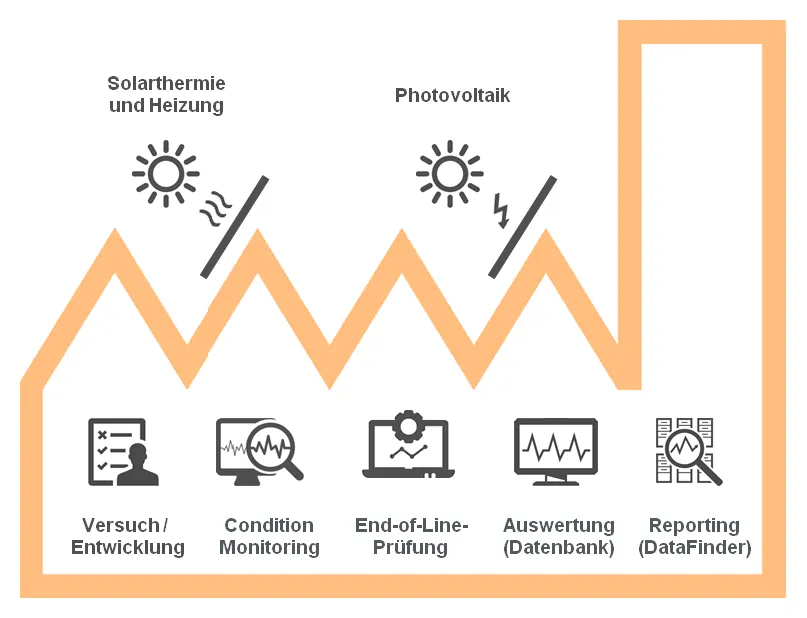
Trade journals and the internet are full of concepts and white papers, but many questions of potential users regarding the concrete implementation of their tasks remain unanswered. That is why we at müller+krahmer have brought together typical digitalization solutions from our daily work in our virtual factory. At https://www.mueller-krahmer.de/en/iiot-en/, web-based visualizations based on real data acquisition, data storage and data analysis are available around the clock. Data is exchanged between field devices, a virtual server and cloud-based data storage using standardized communication protocols such as MQTT, OPC UA and SQL. PCs, Raspberry Pi, PLCs with an integrated IoT interface or embedded controllers serve as edge nodes, i.e. as the interface to the process and the platform for data preprocessing. The solutions are created with National Instruments products such as LabVIEW, LabVIEW NXG Web Module, DIAdem and SystemLink as well as with open-source software such as Python and MySQL.
Nine application examples are currently shown. For example, the monitoring of a combined heating and solar thermal system demonstrates a retrofit, i.e. upgrading an existing system by installing external sensors – without any intervention in the existing system and the associated loss of warranty. At the same time, it impressively proves the benefit of such a solution: thanks to the available long-term data, the heating settings could be optimized and heating costs reduced to a third of the original value. A completely different approach to retrofitting can be found under end-of-line testing, where an existing digital test system was subsequently equipped with a web-based user interface for remote access.
Further examples deal with automated data analysis, data search with and without a database, or simple ways of acquiring and visualizing data on different systems, each of which improves the understanding of the respective process. Each example contains a graphical representation of the system structure of hardware and software that illustrates the respective solution approach to the visitor.
The virtual factory of müller+krahmer was deliberately built without using the complex, confusing and expensive cloud platforms of the major providers. The solutions shown can be used either in a private cloud (e.g. in the intranet) or in a public cloud (using infrastructure on the internet) – without any fundamental restructuring. The sample applications are just as suitable for the needs of small and medium-sized enterprises as for the countless “small” digitalization tasks in large companies. After all, even there it is by no means always about networking entire production plants and factory halls. Considerable effects can often be achieved there, too, with moderate measures for manageable topics in development or production.